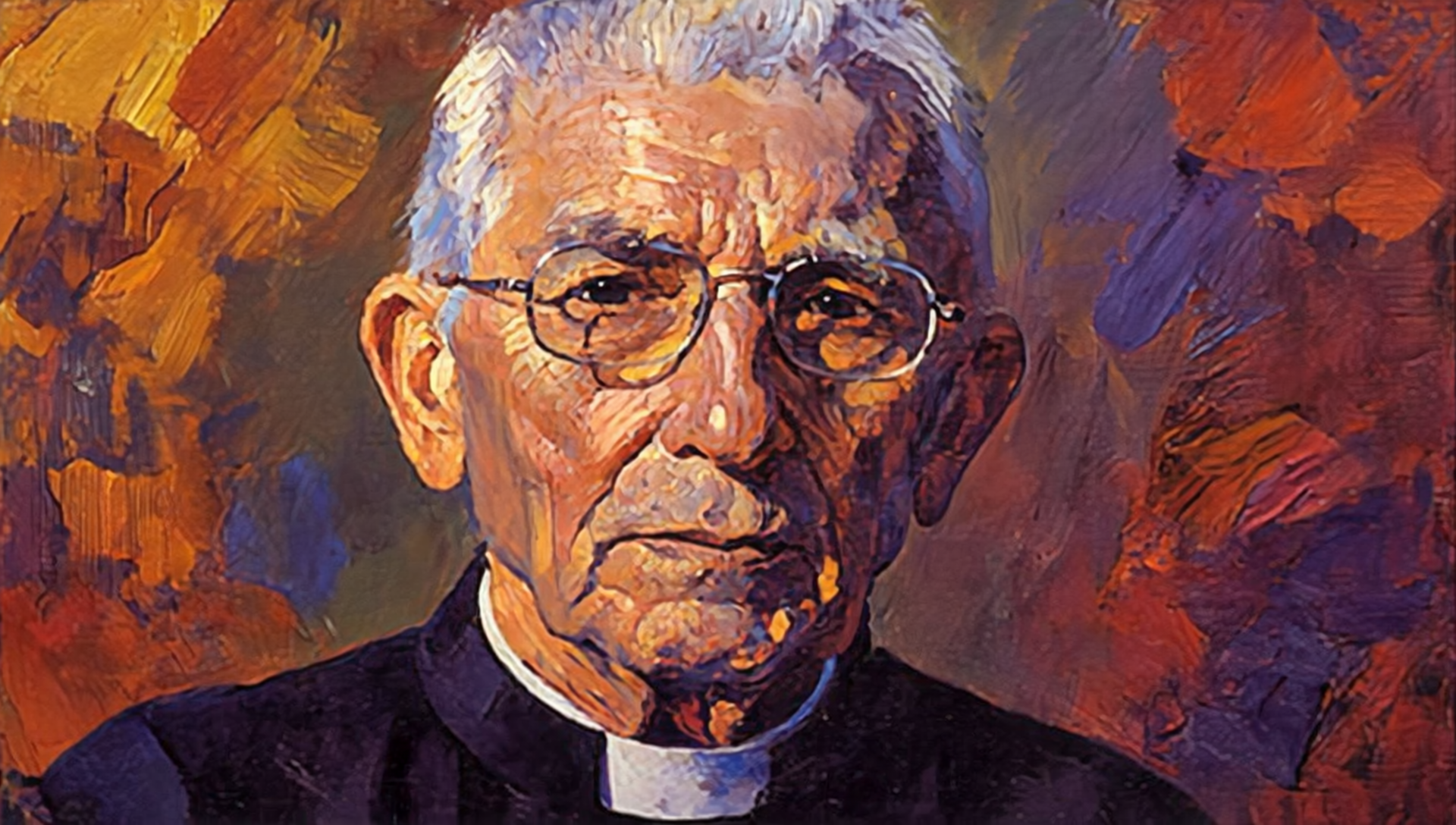
出生地
意大利 西西里島
San Giovanni la Punta
(卡塔尼亞)
出生日期
1915年4月3日
去世日期
2017年11月6日
享年:102
身份
慈幼會士
列品案開始日期
2026年1月17日
相關報道
天主忠僕胡子義神父領受司鐸聖職 80 周年 麻风病人的天使,慈幼会胡子义神父安息主怀 PIME asianews《梵蒂岡連線》- 傳教士的熱忱 鹽與光
天主忠僕胡子義神父列真福品案公開啟動禮
香港天主教教區檔案:紀念亡者
服務麻瘋病人的掃地神父(正報,澳門 2015年 3月 16日)
胡神父小傳(正報,澳門 2015年 3月 16日)
家庭通訊
知遇之恩 #211期我所認識的胡子義神父#216期
我生命中的大恩人、一位愛的使者 #238
澳門團體慶祝胡子義神父百歲壽辰 #245期
胡子義神父安息主懷 #261期
胡子義神父的晚年 #263期
胡子義神父逝世四週年紀念 #286期
懷念胡子義神父:他生命的簡短筆記 #296期
他生命的簡短筆記—懷念胡子義神父 #297期
生之可貴 死而無憾 #301期
啟動天主之僕胡子義神父的列品程序 #308期
胡子義神父列品程序公告 #308期
追蹤胡子義神父的朝聖人生 #309期
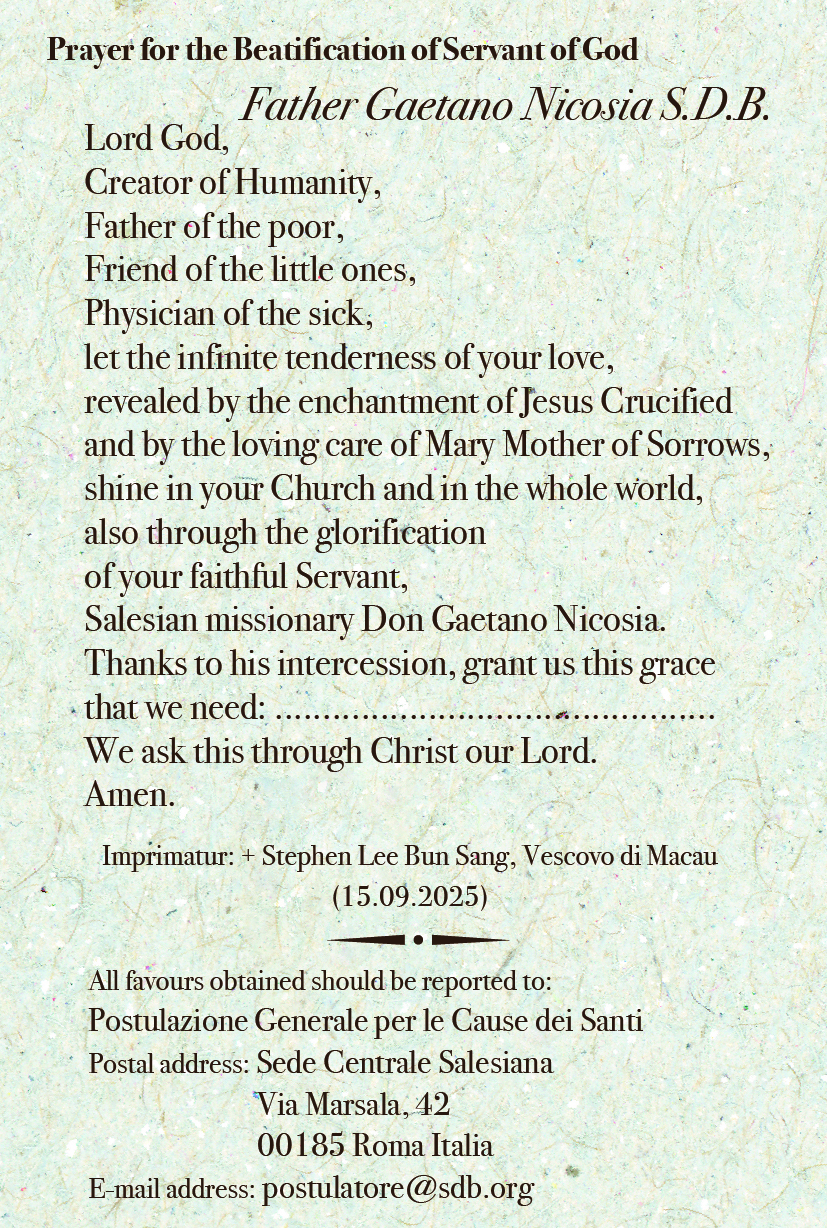



BRIEF BIOGRAPHICAL PROFILE
OF CHINA MISSIONARY SERVANT OF GOD FR. GAETANO NICOSIA S.D.B.
(1915-2017)
Gaetano Nicosia was born in San Giovanni la Punta, in the province of Catania, on April 3, 1915. Of humble origins, at the age of two he lost his father, who died of an illness contracted on the battlefront during the First World War. He grew up in a family accompanied only by his mother Grazia and his elder brother Salvatore, creating with them a wonderful trio of affection and love.
At the age of five, Gaetano begins to discover Don Bosco, attending the Sunday Oratory organized by the young Salesians of Catania in the Mother Church of San Giovanni la Punta. Prepared by the young Salesians of the Oratory, he makes his First Communion at the age of seven. At eleven, he enters the Salesian school in Caltagirone, where for the first time he perceives the divine call to dedicate his life to serving those affected by Hansen's disease. At sixteen, he decides to follow his Salesian vocation, entering the Salesian Aspirantate in Pedara. At seventeen, he discerns his missionary vocation, entering the Missionary Aspirantate in Gaeta. Having completed his training there, in 1935, at the age of twenty, he is sent to China as an aspirant missionary, arriving in Hong Kong on November 2.
Gaetano Nicosia begins his novitiate at the Salesian Missionary House in Shau Kei Wan on December 8, 1935. One of his novice companions, a few years later, would give his life for the faith in Communist prisons on the mainland. Gaetano's physical constitution is frail, and the novice master does not consider it appropriate for him to make his religious profession together with his companions and wants to repatriate him. Gaetano therefore entrusts himself to Father Provincial, Don Carlo Braga: "I went to him in tears to prevent my repatriation. He looked at me, listened to me, and trusted me." Six months later than his novitiate companions, on June 4, 1937, Feast of the Sacred Heart of Jesus, Gaetano takes his first vows as a Salesian of Don Bosco.
In 1939, cleric Gaetano Nicosia is assigned to the Macau Salesian Orphanage (now Instituto Salesiano) for practical training. These were war years. Thousands of refugees from China and Hong Kong take refuge in neutral Macau. People are dying of hunger: "We had eight-hundred students in our school. The Governor gave us a portion of the rice that arrived from Thailand every Friday. And that's how we saved the boys' lives." When in 1942 the Salesian Society accepts Yuet Wah College, Fr. Michele Suppo and cleric Gaetano Nicosia are the first Salesians to work in that school, spending six years there. These are years in which Gaetano is engaged in both intense catechetical activity and theological studies leading to his priestly ordination, which takes place—again in Macau—on March 25, 1946, Feast of the Annunciation, in the Diocesan Seminary St. Joseph Church. In 1948-1949, Fr. Nicosia works for a year at the nascent Salesian School in Shau Kei Wan and for another year (1949-1950) works as a missionary in the mainland under Msgr. Michele Arduino, Bishop of Shiuchow (now Shaoguan) in Guangdong Province, in one of the oldest Catholic communities in China, dating back to the evangelization of Jesuit Father Matteo Ricci, who lived and worked in that city from 1589 to 1595. Thus Fr. Nicosia witnesses the liberation of Shiuchow on the Feast of Our Lady of the Rosary, October 7, 1949.
Owing to further developments of Communist liberation in mainland China, Fr. Nicosia is no longer able to return to Shiuchow, which he had left in late 1950 to return home to see his mother. Back in Hong Kong in 1952, he dedicates himself for about ten years to educational and pastoral activities in St. Louis School and in St. Anthony's Parish (with the interruption of a year spent at the Aberdeen Trade School, 1956-1957). However, Fr. Nicosia is not fully satisfied with the great work he is doing: he longs to be sent on a mission to the poorest, specifically to those suffering from Hansen's disease, since he had promised this to Jesus as an eleven-year-old boy. Furthermore, on July 17, 1943, the then cleric Gaetano Nicosia had made a vow to the Lord that, if He saved his mother Grazia and his brother Salvatore from the horrors of war, he would dedicate himself totally, with the permission of his Superiors, to caring for Hansenian patients. Just as his Superiors are organizing his assignment to Agua de Dios (a Salesian colony of Hansenians in Colombia) and he is temporarily working in Cheung Chau as Vice-Rector of the community and Director of the Sunday Oratory, the Bishop of Macau, Msgr. Paulo José Tavares, asks the Salesian Provincial Fr. Luigi Massimino for a missionary to send to the Hansenian village on the island of Coloane. Thus, Fr. Nicosia's desire to live his mission among the poorest and most vulnerable is unexpectedly fulfilled.
This was an extremely demanding task, as the Hansenian patients, initially about sixty, then increased to about a hundred, lived in the Coloane Hansenian village in a state of relative abandonment, following the closure of the facilities dedicated to them in China and their concentration in Coloane. Government and Church authorities in Macau are unable to adequately care for them, and the sick, who are confined there, do not receive all the care they need, but only the bare minimum from the doctor in charge who visits them. The Canossian Sisters of Coloane and the parish priest of Taipa, on which Coloane depends, occasionally visit the village. Among the Salesians who, before Fr. Nicosia, occasionally visited the Hansenians of Coloane was Fr. Luigi Montini. He was a cousin of Msgr. Giovanni Battista Montini (the future Paul VI and at the time one of the main officials of the Holy See). Fr. Luigi Montini had obtained substantial funding to establish an agricultural school on the western side of the remote island of Coloane for orphans and refugees from China. He would rush to the Hansenian village on the eastern side of the island when called to administer the Anointing of the Sick, etc.
This occasional care-taking notwithstanding, those suffering from Hansen's disease and sent to the Hansenian village in Coloane are destined to remain there until death, with no hope of returning to their previous state of life. Furthermore, even if they recover, the former Hansenians would probably be rejected by society, so strong is the social stigma attached to their illness. Sad to say, there are some in the Coloane Hansenian village who, in despair, commit suicide by plunging into the sea.
On August 12, 1963, at 3 o'clock in the afternoon, Fr. Nicosia, accompanied by Salesian Brother Maurice Kwan Nim Cheong, lands near Ká-Hó, a remote corner on the eastern side of Coloane Island. The Hansenian village is reachable only by boat, but even the boatmen refuse to disembark, lest they come into contact with the sick, and supplies are hauled ashore with ropes. Fr. Nicosia, upon arriving, gives the village a new name, calling it "Village of Our Lady of Sorrows." There, Fr. Nicosia welcomes the sick and anyone in need of care, not only providing them with medicine, but also, and above all, giving them hope. For forty-seven years, he would be a friend and brother to all, listening to them and offering them comfort at the right time. He then initiates an intervention plan that includes not only medical care for the sick, but also improved hygiene and housing conditions and the provision of work activities: the diet becomes adequate; the environment is kept clean and tidy; the village houses are repaired and renovated; other structures are built, and most notably, in 1966, in collaboration with the Macau Diocese, a church dedicated to Our Lady of Sorrows is erected. Finally, the village becomes self-sufficient in water and energy. Each person is assigned a paid task: some are carpenters, some mechanics, some drivers. Those who are skilled are recruited to farm, do crafts, or raise livestock.
The Village of Our Lady of Sorrows establishes a Council for shared decisions. Fr. Nicosia lives with them, among them, bringing dignity, well-being, and health: he brings doctors and nurses to the facility to provide appropriate medical care. The results are not long in coming: many of the recovered people, for whom Fr. Nicosia takes care to find work, manage to reintegrate into society. In the 1970s, about forty people are discharged. Another seventy gradually return to live in the world. For some, however, reintegration remains difficult: their families of origin do not accept them. Thus, some decide to return to live in Our Lady's Village.
During those years, Fr. Nicosia's caring for the needy goes hand in hand with intense apostolic activity. Thus, while before his arrival at the Coloane Hansenian village, there were very few Catholics—about fifteen—through his example of life, his sharing of suffering, and his preaching of the Word of God, conversions to the Christian faith multiply over time. The Village of Our Lady of Sorrows comes to be called the "City of Joy," primarily for the care it provides for the souls of its residents, to whom Fr. Nicosia shows another possible way to face the disease and its consequences: that of imitating Christ crucified. This is a sign that the mission's ultimate goal, beyond the material benefits and physical care it could promote, always remains the eternal salvation of souls. Not only does Fr. Nicosia speak of faith, but his testimony is such that all the residents of the former leper colony convert to the Catholic Church.
A large number of willing people, attracted by the example of Don Gaetano Nicosia, become successively involved in his work of faith and love for our Hansenian brothers and sisters: the Sisters Announcers of the Lord (SAL), the Volunteers of Don Bosco (VDB), the Sisters of Our Lady of the Angels (MNDA), the Franciscan Missionaries of Mary (FMM), and the Sisters of Charity of St. Anne (HCSA) who to this day are still working there in the Centro de Santa Lúcia. Of great help to Fr. Gaetano Nicosia are also the other three great lovers of the poor in Macau: the Jesuit Fr. Luís Ruiz Suárez SJ, Canossian Sister Mother Maria Goisis FdCC, and the diocesan priest Fr. Lancelote Miguel Rodrigues. Many other people from Macau, including members of Government, members of medical and nursing services, members of ecclesiastical and civil associations, and members of the diocesan and religious clergy, offer their help to Fr. Nicosia, who is also supported by a dense network of benefactors from around the world. Admirable, too, is the close collaborative relationship that Fr. Nicosia cultivates with all the leading ecclesiastical authorities (Bishops) and civil authorities (Governors and Chief Executives) of Macau.
The Village of Our Lady of Sorrows is about a kilometre away from Ká-Hó, the nearest village, which is full of children. Don Gaetano Nicosia also cares for them, organizing the Sunday Oratory among them on the very second Sunday after his arrival in Coloane. For children and adolescents who have no other educational opportunities, Don Gaetano Nicosia builds two schools in Ká-Hó: the Escola S. José for little boys and girls and the Escola Dom Luís Versiglia for adolescents. Both schools are boarding schools. He later entrusts the first to the care of the Daughters of Mary Help of Christians, the second to the care of the Salesians of Don Bosco.
For spastic children, Fr. Nicosia has already opened a centre in 1968 in a villa donated by the bishop on the Penha. Similarly, near the Village of Our Lady of Sorrows, the Santa Lucia Centre for needy women is established. Beginning in 1980, Fr. Nicosia helps thousands of Hansenians in Guangdong Province, where he collaborates with local authorities to help the sick and the children of Hansenians, offering them education and support for their future. Not without reason has Fr. Gaetano Nicosia been called the "Angel of Hansenians" and the "Father of poor and abandoned children".
Fr. Nicosia's work in Coloane, Macau, and the mainland continues uninterrupted until 23 September, 2010, when a serious fall threatens his health and he has to be admitted to hospital. On October 11, he is transferred to Hong Kong, first to St. Paul's Hospital of the Sisters of St. Paul de Chartres (SPC) in Causeway Bay, and then to St. Mary's Home for the Aged of the Little Sisters of the Poor (LSP) in Wong Chuk Hang (with a two-year interruption, 2015-2016, in the Braga House of Salesian Missionary House in Shau Kei Wan).
In his later years, when his physical weakness and health deteriorate due to age, he still manages to go to Italy twice, accompanied by Bishop Emeritus of Hong Kong, Salesian Cardinal Joseph Zen Ze Kiun. First in 2012, to participate in the Beatification of his fellow countryman and bosom friend, Father Gabriele Maria Allegra, O.F.M., in Acireale (Catania). Then in 2015, for his own centenary and Don Bosco's bi-centenary, he meets Pope Francis and Pope Emeritus Benedict XVI in Rome, and the new Rector Major of the Salesians, Fr. Ángel Fernández Artime, in Turin.
Fr. Gaetano Nicosia is finally born into heaven, as we hope, on the evening of November 6, 2017, aged one hundred-and-two, after a life entirely dedicated to living Don Bosco's "Da mihi animas cetera tolle". He dies surrounded by a dozen people: Salesians, Don Bosco Volunteers, a Little Sister of the Poor, regular and volunteer attendants, former pupils of his schools, and two teenagers, all praying around his bed. He remains lucid until the last moments. That morning—sensing that the hour of his death had arrived—he had asked a Little Sister of the Poor to find a Salesian priest for the anointing of the sick. The Salesians arrive, and Cardinal Joseph Zen celebrates Holy Mass at his bedside, allowing Fr. Nicosia to receive his Last Communion (Viaticum) shortly before his death.
A double funeral is celebrated for him. The first is held in Hong Kong at St. Anthony's Church, where Fr. Nicosia had served as a young priest for ten years, with Requiem Mass on the evening of Friday, November 10, and Funeral Mass on the afternoon of Saturday, November 11. On Sunday, November 12, his mortal remains are transported (via mainland China) to Macau, where Fr. Nicosia had spent fifty-six years of his long life. The second funeral takes place in the Macau Cathedral, with Requiem Mass on the evening of Monday, November 13, and Funeral Mass on the morning of Tuesday, November 14. His mortal remains are then buried at St. Michael's Cemetery in Macau, in the Salesian burial ground, where the mortal remains of the Salesians who died in Macau "await the resurrection."
Responding to the widespread belief that God had impressed a splendid sign of his loving presence in the life and work of Fr. Gaetano Nicosia, Bishop Stephen Lee Bun Sang of Macau on January 17, 2026, in the Church of Our Lady of Sorrows in Coloane, surrounded by a crowd of faithful, publicly opens the Diocesan Inquiry into the reputation for sanctity and intercession, and the heroic virtues of "Servant of God Fr. Gaetano Nicosia, Salesian missionary to China".